Terminal Operating System (TOS): A Guide to Smarter, More Efficient Terminal Operations

blog-TOS-post-image

For Ports, Container, Bulk, Break Bulk and RoRo Terminals

Walk onto the control tower of almost any container terminal at 2 a.m. during a vessel exchange and you’ll see the same thing: planners staring at screens, radios crackling and one question hanging over the room — will the yard hold up until the next ship clears the berth. That question, repeated thousands of times a year, is exactly what a Terminal Operating System exists to answer.

The stakes have gotten bigger. UNCTAD’s Review of Maritime Transport has tracked global container throughput past 850 million TEU a year and vessels have grown from the 8,000 TEU ships common a decade ago to units carrying 24,000 TEU or more. Every extra box has to be planned, stowed, moved, tracked and billed correctly — and one missed crane move on a mega-vessel call can ripple into hours of delay and congestion charges showing up on a P&L statement weeks later.

That’s the reality a Terminal Operating System (TOS) manages: the nervous system deciding which crane moves next, where a container gets stacked and whether a truck waits ten minutes or ninety at the gate.

What Is a Terminal Operating System?

A Terminal Operating System is the software platform that plans, executes and tracks the physical movement of cargo through a marine, rail or intermodal terminal — from the moment a vessel is nominated to berth through gate release, rail dispatch and final billing.

At its simplest, a TOS answers four questions continuously, in real time: where is this container right now, where does it need to go next, which piece of equipment should move it and who pays for the move. That sounds simple until you multiply it across a terminal handling 10,000 container moves a day, five active vessels, three rail tracks and a gate processing a truck every ninety seconds.

Who Actually Runs on a TOS Today

How the Category Evolved

Early TOS platforms in the 1990s were little more than digital yard inventories — glorified spreadsheets tracking where boxes sat. The second generation, through the 2000s, added planning logic: berth sequencing, stowage optimization and EDI messaging with shipping lines. What we call a modern Terminal Operating System today is a third-generation platform — cloud-native or cloud-capable, API-first, built to optimize decisions in real time rather than just record them and increasingly layered with AI-driven planning that recommends the next move instead of waiting for a planner to figure it out manually.

Cloud vs. On-Premise

This is still a live decision for many terminal operators, not a settled question. On-premise deployments remain common at mega-terminals running fully automated stacking cranes, where microsecond-level latency to equipment controllers genuinely matters and IT teams want the hardware in the building. Cloud and hybrid deployments have become the default for mid-size and growing terminals, because they cut upfront capital cost, simplify disaster recovery and let a vendor push improvements without a disruptive on-site upgrade project. Most vendors now offer both and the honest answer to “which is better” is: it depends on your automation level, your IT staffing and how many sites you’re trying to run on one instance.

AI in the TOS Layer

AI planning has moved past the marketing slide. Planning engines now use historical move data and live yard conditions to recommend berth windows, flag equipment bottlenecks before they happen and auto-suggest yard slotting that reduces re-handles. It’s not autonomous decision-making yet at most terminals — a human planner still approves the plan — but the assistive layer is real and measurably reduces planning time at terminals that have adopted it.

How Does a Terminal Operating System Work?

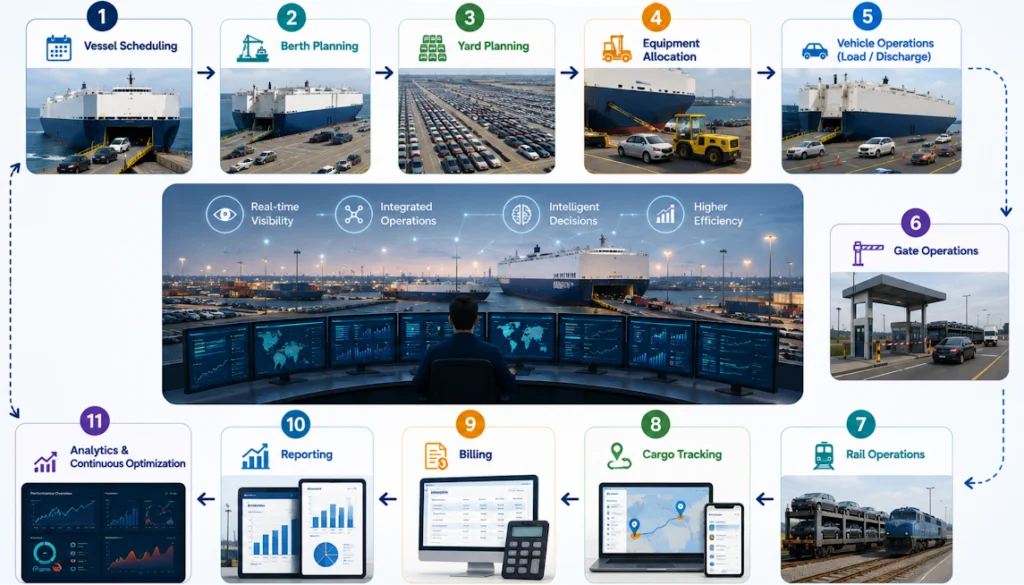
Think of a TOS as a relay race where the baton is a container and every stage has to hand off cleanly or the whole race slows down. The core workflow runs as follows:

Vessel scheduling starts days or weeks out, as shipping lines send arrival notices via EDI (BAPLIE, COPRAR and related messages). The TOS reconciles that against berth windows already committed to other carriers.

Berth planning decides which vessel gets which berth, at what time and — critically — in what sequence relative to other ships already alongside. Get this wrong and you either leave a berth idle (lost revenue) or double-book a slot (a vessel waiting offshore burning bunker fuel and racking up demurrage disputes).

Yard planning determines where every inbound and outbound container gets stacked. This is where experience really shows: a naive system stacks by “next available slot,” while a mature TOS stacks by discharge sequence, weight class, destination and dwell forecast, so that when the outbound vessel arrives, the right boxes are already positioned near the quay instead of buried six deep in the wrong block.

Equipment allocation assigns quay cranes, yard cranes (RTGs/RMGs) and terminal tractors to specific moves, sequenced to avoid equipment collisions and idle travel time.

Container operations is the actual load/discharge execution, tracked move by move, often with crane-mounted position systems or OCR feeding data back into the TOS in real time.

Gate operations manage truck arrival, container verification (increasingly via automated OCR gates) and release — the single biggest visible pain point for trucking companies and a major driver of community complaints near busy ports.

Rail operations coordinate train arrival, wagon-to-container matching and yard-to-rail moves for terminals with intermodal connectivity.

Cargo tracking, billing, reporting and analytics close the loop — converting every move into a billable event, a KPI data point and eventually a pattern the planning engine learns from for next time.

Core Modules of a Modern Terminal Operating System

Module Purpose Typical User Pain Point Solved KPI Improved
Berth Planning Sequence vessel arrivals against berth capacity Marine planner Double-booked berths, idle quay time Berth utilization, waiting time
Vessel Planning Stowage sequencing and discharge/load ordering Vessel planner Re-handles, stability errors Crane moves per hour
Yard Management Slotting, stacking logic, block/bay optimization Yard planner Yard congestion, buried containers Yard utilization, re-handle ratio
Gate Management Truck appointment, OCR check-in, release Gate supervisor Truck queues, manual paperwork Truck turnaround time
Rail Management Train-to-yard coordination Rail coordinator Missed rail windows Rail dwell time
Equipment Control Real-time crane/tractor dispatch Operations control room Idle equipment, radio confusion Equipment utilization
Cargo Tracking Container status visibility end-to-end Customer service "Where is my box" calls Track-and-trace accuracy
EDI Integration Automated messaging with lines, customs, ports IT / Ops Manual data entry errors Data accuracy, cycle time
Billing Automated invoicing tied to move events Finance Revenue leakage, disputes Billing accuracy, DSO
Dashboard Live operational visibility Terminal manager Delayed problem detection Decision speed
Reporting Regulatory and management reporting Compliance, management Manual report compilation Reporting cycle time
AI Planning Recommended plans from live + historical data Planners Planning time, suboptimal plans Planning cycle time
Predictive Analytics Forecast congestion, delays, demand Operations leadership Reactive firefighting Forecast accuracy

Business Benefits

The below mentioned ranges reflect what terminals commonly report after a properly scoped implementation — actual results depend heavily on starting maturity, cargo mix and how much of the platform’s capability is actually adopted by planners day to day.

Benefit Area Typical Improvement Range
Planning speed 20–40% faster
Operational cost 15–30% lower
Yard utilization Up to 25% improvement
Planning conflicts 40% fewer
Truck turnaround time 15–25% faster
Overall productivity ~20% improvement

Prioritize platforms built on open API architectures with documented EDI support (UN/EDIFACT, ANSI X12, or port community system standards). Proprietary data silos are the enemy of operational agility.

Terminal Types Supported

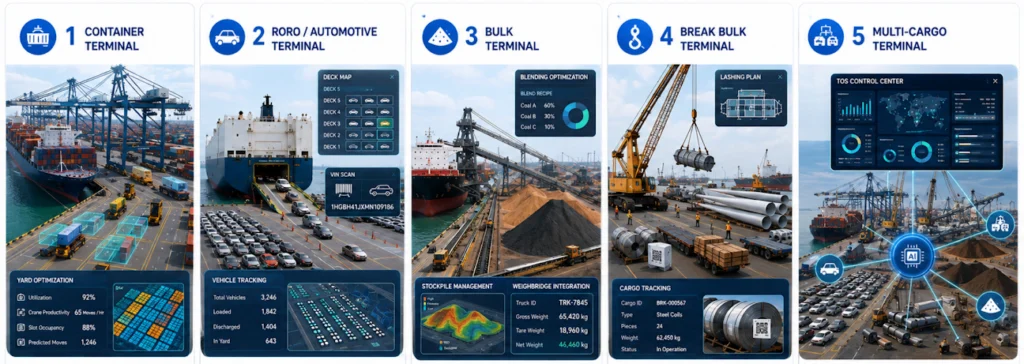
Terminal Type Key TOS Requirements
Container High-throughput yard slotting, crane sequencing, stowage optimization
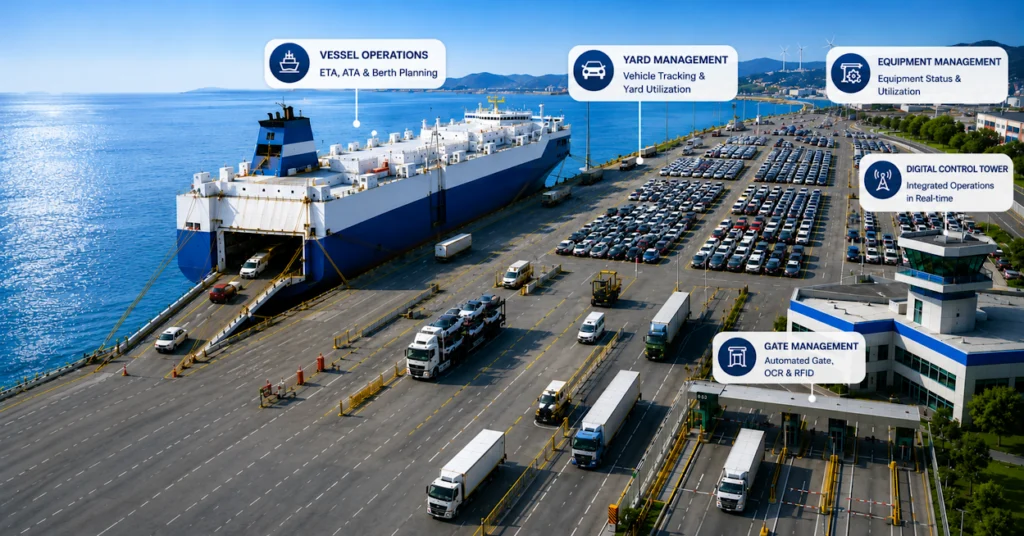
RoRo / Automotive Vehicle VIN tracking, deck/lane mapping, driver dispatch
Bulk Commodity blending, weighbridge integration, stockpile management
Break Bulk Piece-level tracking, lashing/securing plans, project cargo handling
Liquid Bulk Tank allocation, pipeline scheduling, product segregation
General Cargo Warehouse slotting, mixed commodity handling
Multi-Cargo Unified platform spanning several cargo types on one site

A container terminal and a bulk terminal are, functionally, running different businesses on the same waterfront — which is why “one-size-fits-all” TOS claims deserve scrutiny. A platform strong in container yard optimization isn’t automatically strong in bulk stockpile blending logic and vice versa. Multi-cargo terminals in particular should push vendors hard on reference sites that match their actual cargo mix.

Implementation Timeline

Phase Typical Duration Key Activities
Discovery 2–4 weeks Current-state assessment, stakeholder interviews
Business Analysis 3–6 weeks Process mapping, gap analysis, requirements sign-off
Configuration 6–12 weeks System setup, business rules, yard/berth modeling
Data Migration 3–6 weeks Master data cleanup, historical data transfer
Integration 4–10 weeks EDI, ERP, equipment control system connections
Testing 4–8 weeks UAT, load testing, failover testing
Training 2–4 weeks Role-based training, super-user certification
Go Live 1–2 weeks Cutover, parallel run if applicable
Hypercare 4–8 weeks Intensive post-launch support, rapid issue resolution

Implementation Challenges

Legacy systems. Older TOS platforms and adjacent tools (gate systems, billing) often use data structures that don’t map cleanly to a modern platform. Budget real time for reconciliation, not just a data export/import script.

Data quality. Migrating twenty years of yard history sounds valuable until you discover half the container status codes were entered inconsistently by different shifts. Clean data before migration, not after.

User adoption. The single most underestimated risk. Planners who’ve run a yard from memory and intuition for fifteen years will resist a system telling them where to stack — not out of stubbornness, but because trust in automated recommendations has to be earned through visible, repeated accuracy.

Integration. EDI with shipping lines, customs systems and equipment control systems is rarely as “standard” as vendors imply. Plan a dedicated integration testing phase with real trading partners, not just sandbox data.

Training. Role-based training matters more than generic system training. A gate clerk and a vessel planner need almost entirely different skill-building.

Risk mitigation. Parallel-running old and new systems during cutover, even for a short window, catches configuration gaps before they become live operational incidents.

Conclusion

A Terminal Operating System is the operational backbone that determines whether your terminal turns vessels quickly, keeps trucking partners moving and gives finance data it can trust. Compare providers on business outcomes — berth utilization, re-handle ratio, truck turnaround — not feature checklists and talk to reference customers before you talk to sales teams. If you’re early in evaluating platforms, a short conversation scoped to your actual cargo mix and automation roadmap will surface more than another round of vendor brochures.

Frequently Asked Questions

What is a Terminal Operating System?

Software that plans and executes cargo movement through a terminal — vessel scheduling, berth/yard planning, equipment dispatch, gate operations and billing.

 TOS cost is best determined after understanding the terminal’s operational requirements and defining the required scope. This enables us to propose an appropriately sized solution and a commercial model aligned with the terminal’s actual operational needs.

The typical TOS implementation timeline is approximately 8–16 weeks, depending on the agreed scope, terminal configuration, selected modules, customization requirements, system and equipment integrations, data migration, testing, and user training.

Depends on automation level and IT staffing; most vendors now offer both.

Yes, via API and EDI, though pre-built connector depth varies by vendor.

Yes, Some platforms are purpose-built for it; others are container specialists — confirm against your actual cargo mix.

Typically 2–3 weeks of intensive vendor support as real volume hits the new system.