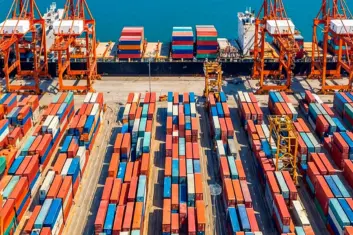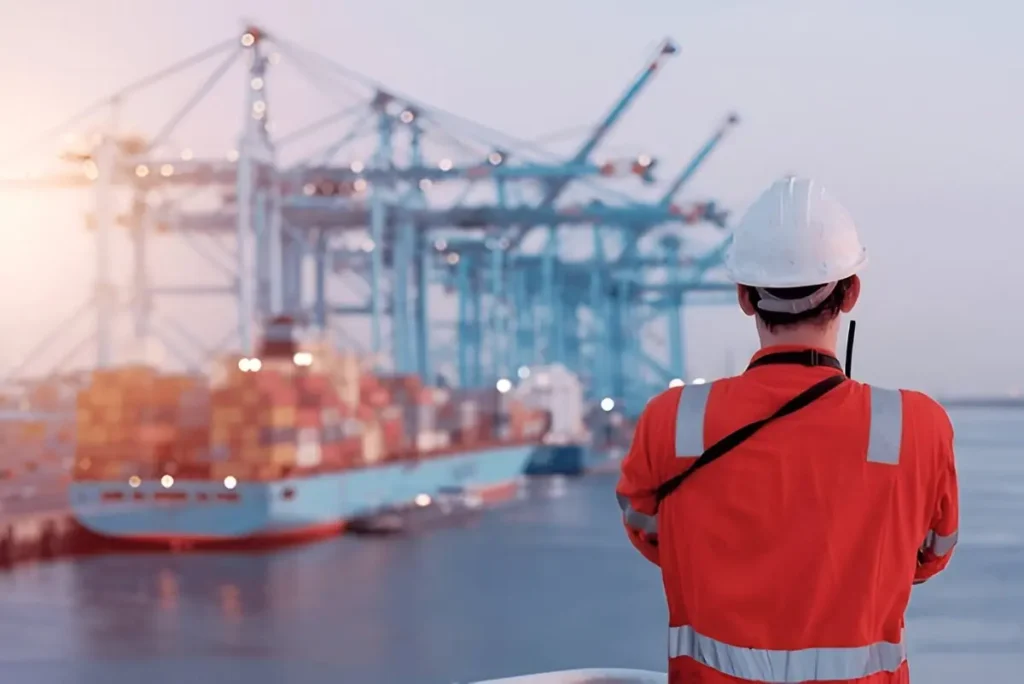
Picture a mid-size terminal on a Tuesday morning. Containers are stacking up in one block while a RoRo vessel is due at berth 3 in four hours. Meanwhile, a bulk carrier is discharging aggregate onto an open stockpile and a breakbulk shipment of oversized machinery sits on a flatbed truck waiting on a crane slot that hasn’t been confirmed yet. The yard planner is working off a spreadsheet that was last updated an hour ago. The gate supervisor is fielding calls about a truck that showed up without the right paperwork. Someone in the office is trying to figure out whether the crew scheduled for container moves can also handle the breakbulk lift, or whether that’s going to blow the vessel’s turnaround time.
None of this is unusual. It’s just what a multi-cargo terminal looks like on an average day.
Terminals that handle only one cargo type can standardize a lot of their operation around that cargo. A pure container terminal can build its yard, its equipment fleet and its software around box moves. A multi-cargo terminal doesn’t get that luxury. Containers, vehicles, bulk, breakbulk and sometimes liquid cargo all move through the same footprint, often at the same time, each with its own rules for storage, handling and tracking.
That’s where a multi cargo terminal operating system comes in. It isn’t a container TOS with a few extra fields added on. It’s a platform built around the reality that different cargo types need different workflows and that those workflows still have to share the same berths, yard space, gates and equipment without stepping on each other.
This guide looks at what a multi-cargo terminal operating system actually does, why multi-cargo operations are harder to manage than single-cargo ones and what to look for if you’re evaluating a platform for your terminal.
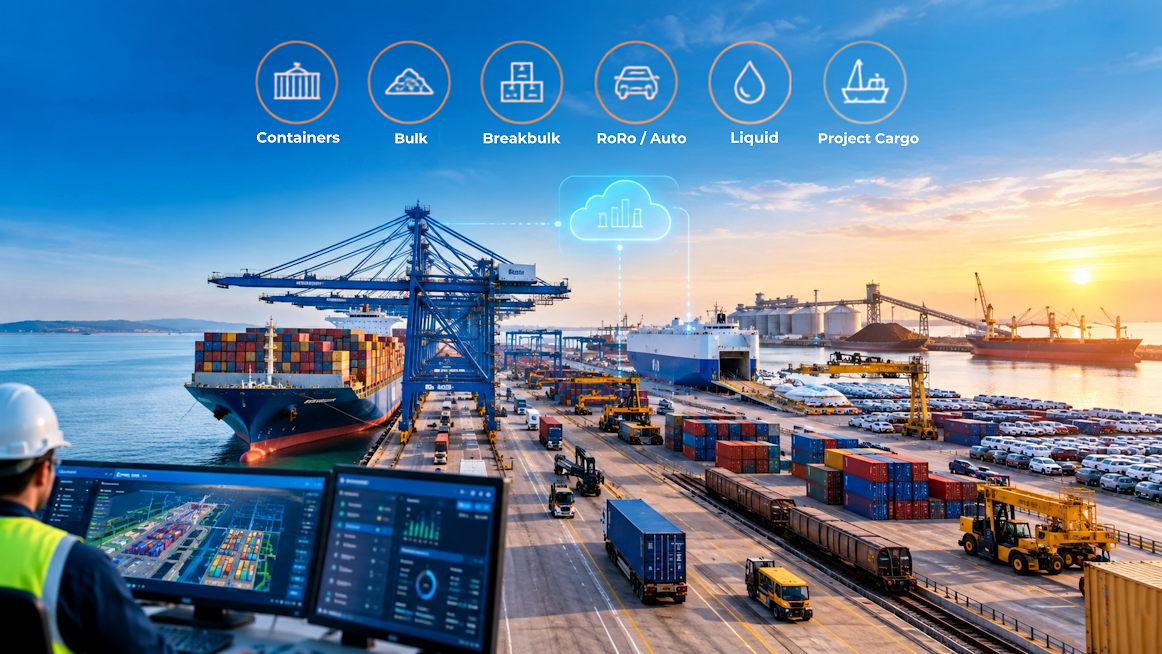
A multi cargo terminal operating system is software that manages the full range of operations at a terminal handling more than one type of cargo — containers, RoRo and automotive, bulk, breakbulk, liquid and project cargo — inside one operational environment.
The point isn’t just that it can “handle” different cargo types. It’s that it lets each cargo type follow its own logic while still giving the terminal a single, shared view of the yard, the berths, the equipment and the vessel schedule.
Think about how differently a container and a vehicle behave in a yard. A container is a standardized unit. It has a fixed size, it stacks predictably and its handling rules don’t change much from box to box. A vehicle isn’t like that. It may need to be tracked by VIN, model, trim, destination and condition and it has to be parked, not stacked. Bulk cargo behaves differently again — it’s measured in tonnage and stockpile volume, not units. Break bulk cargo might be a single oversized item that needs its own storage plan and a specific piece of lifting equipment.
A single-cargo TOS doesn’t need to account for any of that variation. A multi-cargo terminal operating system does — and it has to do it without turning every workflow into a compromise that half-fits every cargo type.
Managing one cargo type well is hard enough. Managing several at once, through the same terminal, is a different kind of problem.
Start with the yard. A container yard is planned around stacking height, weight distribution and dwell time. A vehicle yard is planned around parking rows, access lanes and turning radius. A bulk storage area is planned around stockpile capacity and material segregation. Now put all three in the same terminal and the yard planner has to think about how space allocated to one cargo type affects what’s available for another — especially when a vessel shows up earlier than expected and the yard wasn’t quite ready for it.
Equipment adds another layer. A reach stacker built for containers isn’t much use for loading vehicles onto a car carrier and neither is any use for shifting a stockpile of bulk material. Multi-cargo terminals typically run several categories of equipment and figuring out which crew and machine should be where, at what time, with three cargo operations running in parallel, isn’t something you can manage well from memory or a whiteboard.
Then there’s tracking. Containers move as units with container numbers. Vehicles need to be tracked individually, sometimes down to condition notes and customer-specific handling instructions. Bulk cargo is tracked by volume and location within a stockpile, not by individual item. Each of these needs a different data structure and if your systems don’t talk to each other, you end up with cargo visibility that’s accurate for one cargo type and outdated for another.
The problem isn’t always the amount of cargo.
It is the lack of visibility between operations.
A lot of terminals manage this today with a mix of spreadsheets, a legacy system built around one cargo type, manual gate logs and a lot of phone calls between the yard, the gate and the office. It works, in the sense that cargo does eventually move. But every handoff between systems and people is a place where something can get missed — a vessel ETA change that doesn’t reach the yard team in time, a truck that arrives at the gate without a record of its booking, a stockpile that’s reported as one volume in the office and a different volume on the ground.
Not every terminal handles every cargo type and a good multi-cargo TOS shouldn’t assume you do. It should support the mix that’s actually relevant to your operation, without forcing you to configure workflows you’ll never use.
Container operations are usually the most standardized part of a multi-cargo terminal, but that doesn’t make them simple. You still need accurate yard planning to avoid unnecessary restacks, gate operations that can process trucks quickly during peak hours and equipment coordination that keeps cranes, yard trucks and stacking equipment working in sync with the vessel plan.
Vehicle operations run on different logic entirely. Vehicles typically need VIN-level tracking, not just a count. You need to know exactly where each vehicle is parked, what condition it arrived in, whether it’s cleared inspection and what its dispatch instructions are — which can vary by customer or by OEM. A vehicle terminal cannot always work the way a container terminal does and a TOS that treats vehicles like oversized boxes will create more problems than it solves.
Bulk cargo — grain, ore, aggregate, coal and similar materials — is managed by volume and location rather than by individual unit. The operational questions are different too: how much is in each stockpile, how fast is it moving in and out and how are you keeping different materials from mixing where they shouldn’t. Equipment and material movement tracking matter more here than unit-level tracking.
Breakbulk cargo resists standardization more than any other category. Dimensions vary, weight varies and handling requirements vary from shipment to shipment. Storage often needs to be planned individually rather than assigned from a standard yard grid and the equipment required — heavy lift cranes, specialized rigging — has to be scheduled around the specific item, not a generic cargo type.
Terminals that handle liquid bulk are working with a different set of concerns entirely: tank allocation, transfer scheduling, inventory levels by product and monitoring rather than physical yard movement. A multi-cargo TOS that supports liquid cargo needs workflows built around tanks and transfers, not stacking and parking.
Project cargo — oversized machinery, wind turbine components, industrial equipment — tends to be one-off by nature. It needs configurable workflows more than any other cargo type, because no two project cargo shipments look quite the same.
Feature lists are easy to write and easy to skim past. What matters is what each one is actually solving for.
The operational flow generally runs: vessel arrival, berth planning, cargo discharge, yard planning, cargo tracking, equipment allocation, gate operations, dispatch, billing, reporting and analytics.
In a single-cargo terminal, that flow is fairly linear. In a multi-cargo terminal, several versions of it are often running at once, for different cargo types, competing for shared resources.
Let’s assume a terminal receiving a container vessel and a RoRo vessel on the same day. Berth planning has to account for both vessels’ turnaround priorities. As containers are discharged, the yard planning module assigns stacking positions based on current occupancy and outbound schedules. At the same time, vehicles coming off the RoRo vessel are being logged by VIN and directed to designated parking areas, with inspection status tracked separately from container cargo. Equipment allocation draws from a shared pool — the same terminal staff scheduling reach stackers for containers also need to account for the tow tractors moving vehicles.
And gate operations for both cargo types run through the same gate infrastructure, even though the paperwork and processing steps differ between a container pickup and a vehicle release. Dispatch, billing and reporting all draw from the same operational data, which is what lets a terminal manager pull one report and see cargo throughput across both operations rather than reconciling two separate systems by hand.
That’s the practical value of running this on one platform. Information generated at the berth is available to the yard team immediately. Information generated in the yard is available to the gate. Nobody is re-entering the same data twice and nobody is working from a version of the schedule that’s already out of date.
Traditional terminal systems were often built around one cargo type — usually containers — because that’s where terminal automation started. Extending that kind of system to handle vehicles, bulk, or breakbulk usually means bolting on workarounds rather than building in native support.
The practical differences show up in a few areas. Cargo flexibility is the most obvious one: a system designed for containers has to be stretched to handle VIN-level vehicle tracking or stockpile-based bulk inventory and the stretch usually shows. Workflow configuration tends to be more rigid in traditional systems, because the underlying data model wasn’t designed with multiple cargo logics in mind. Yard planning and tracking inherit the same limitation — a yard module built for container stacking doesn’t translate cleanly to vehicle parking or bulk stockpiles.
Integration and scalability are where the gap widens further. A single-cargo system extended piecemeal over the years tends to accumulate technical debt, which makes new integrations harder and reporting less consistent across cargo types. A platform built for multi-cargo operations from the outset treats reporting and automation across cargo types as a core function, not an add-on.
None of this means traditional systems are poorly built for what they were designed to do. It means they were designed for a narrower job and terminals that have grown into multi-cargo operations often find the limits of that design the hard way — usually around the time a new cargo type gets added and the existing system can’t accommodate it without a workaround.
AI has a real, practical role in multi-cargo terminal operations, but it’s worth being specific about what that role actually is.
Yard planning is one of the clearer use cases. With several cargo types competing for space, AI can help recommend stacking or storage positions based on current occupancy, expected dwell time and upcoming vessel schedules — surfacing options faster than a planner working through it manually.
Predicting operational bottlenecks is another. If equipment allocation, gate throughput and vessel schedules all feed into the same system, AI can flag where congestion is likely to build before it actually happens, giving the operations team time to adjust.
Equipment allocation and cargo movement optimization benefit from the same kind of pattern recognition — matching machines and crews to jobs more efficiently across cargo types, especially when multiple operations are running at once.
Exception detection works differently. It can flag a cargo record that doesn’t match expected patterns, a vehicle that hasn’t moved in longer than expected, or a discrepancy between reported and physical stockpile volume, before it turns into a bigger problem.
ETA-based planning and demand forecasting help the terminal prepare for what’s coming rather than reacting once it arrives, which matters more when a vessel shows up early and the yard needs to adjust quickly.
What AI isn’t good for is replacing the judgment of the people who actually run terminal operations. A recommendation engine can suggest a yard position or flag a likely bottleneck, but the decision about how to handle a specific vessel, customer, or cargo exception still belongs to the operations team. The realistic framing is AI supporting operational decisions, not making them independently.
The practical benefits tend to show up in a few consistent areas.
Better visibility means the yard, the gate and the office are working from the same current information instead of versions that are hours apart. Improved yard utilization comes from planning space across cargo types instead of managing each one in isolation. Faster decision-making follows naturally when a manager can see current cargo and yard status without waiting on someone to compile it.
Better equipment utilization comes from coordinating machines and crews across cargo types rather than scheduling each operation separately. Reduced manual work means fewer spreadsheets, fewer phone calls to confirm information that should already be recorded and fewer opportunities for data entry errors. Improved cargo traceability matters to customers who want to know exactly where their cargo is and what condition it’s in, whether that’s a container, a vehicle, or a stockpile.
More coordinated operations and better vessel turnaround planning reduce the chance that one cargo operation slows down another simply because they weren’t planned together. And because the platform is built to handle multiple cargo types from the start, scaling into a new cargo type later doesn’t mean rebuilding the system — it means configuring a new workflow inside the one you already have.
There’s no single feature list that applies to every terminal, but a few questions are worth working through with any vendor you’re evaluating.
The best TOS is not necessarily the one with the longest feature list. It is the one that fits the way the terminal actually works.
Terminals shouldn’t have to redesign their operations around rigid software. Every terminal has its own mix of customer-specific workflows, cargo-specific processes and operational rules that developed for good reasons — a particular OEM’s inspection requirements, a yard layout shaped by the site itself, an operational model built around the terminal’s specific mix of cargo and customers.
A rigid system forces terminals to either compromise on how they operate or invest in expensive customization every time something needs to change. A configurable platform lets the software adapt to the terminal, instead of the other way around. That matters more as terminals grow, add cargo types, or take on customers with their own specific requirements.
Infyz Solutions builds software for ports, shipping lines, terminals and logistics operators, with multi-cargo flexibility built into the platform rather than added on afterward.
The platform supports container, RoRo/automotive, bulk and breakbulk operations within configurable workflows, so each cargo type can follow its own process without forcing the terminal into a one-size-fits-all setup. Yard planning, cargo tracking and equipment allocation are handled across cargo types within the same operational view, which is what gives terminal managers real-time visibility instead of a patchwork of separate reports.
AI-assisted planning is built in to support yard and equipment decisions, not to replace the people making them. The platform is available for mobile-first operations, so yard and gate staff can work from where the cargo actually is and it supports both cloud and on-premise deployment depending on what a terminal’s infrastructure and security requirements call for.
Integration capabilities connect the platform with ERP, customs and other systems terminals already rely on, keeping operational data flowing without duplicate entry. And because the platform is built around configurable workflows rather than rigid, cargo-specific modules, implementation timelines and total cost of ownership tend to be more manageable than retrofitting a single-cargo system to handle a multi-cargo operation.
For a terminal handling multiple cargo types, the operational challenge is usually not a single process. It is coordinating several different processes without losing visibility — and that’s the problem a multi cargo terminal operating system, built the right way, is meant to solve.
Please feel free to share your thoughts, and let’s discuss how we can support your business goals.
It’s software that manages terminal operations — vessel scheduling, yard planning, cargo tracking, gate operations and more — across multiple cargo types like containers, vehicles, bulk and breakbulk, within one operational platform.
Most platforms support containers, RoRo and automotive cargo, bulk cargo, breakbulk and general cargo, liquid cargo and project cargo. Not every terminal needs every cargo type and a good platform lets you configure only the workflows relevant to your operation.
Yes, provided the platform supports the different tracking logic each cargo type needs — unit-based tracking for containers and VIN-level tracking for vehicles — within configurable workflows rather than a single rigid process.
It gives the yard team a shared, real-time view of space allocated to each cargo type, so decisions about stacking, storage and space reallocation account for the whole yard rather than one cargo type in isolation.
A yard management system typically focuses on space and movement within the yard. A terminal operating system covers the broader operation — vessel scheduling, berth planning, gate operations, dispatch, billing and reporting — often with yard management as one component within it.
AI is generally used for yard planning recommendations, bottleneck prediction, equipment allocation and exception detection. It’s a decision-support tool for terminal operators, not a replacement for their judgment.
Yes. Integration with ERP, customs and customer systems is a standard requirement for terminal operating systems and it’s what keeps operational data connected to finance and compliance processes without manual re-entry.
Start with the cargo types and workflows specific to your terminal, then evaluate configurability, real-time visibility, integration capabilities and vendor experience with multi-cargo operations — not just the length of the feature list.
[booking resource_id=1]