
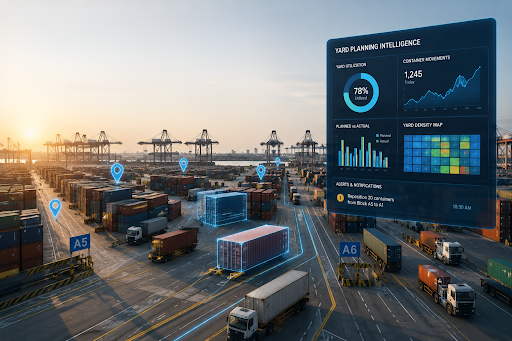
As global logistics networks become more complex, organizations are increasingly investing in a Yard Management System (YMS) to improve visibility, optimize yard operations and maximize asset utilization. From container terminals and inland depots to logistics parks and distribution centers, efficient yard planning has become a critical factor in operational success.
Traditional yard operations often rely on manual planning, spreadsheets and disconnected systems that create inefficiencies, delays and unnecessary operational costs. Modern yard management solutions are changing this landscape by introducing real-time visibility, predictive analytics and AI-powered optimization.
For terminal operators seeking to improve throughput and reduce congestion, yard planning intelligence is becoming a competitive advantage.
A Yard Management System is an intelligence module designed to manage and optimize the movement of containers, trailers, vehicles, equipment and cargo within a terminal or logistics yard.
Advanced product platforms are helping ports, terminals and logistics operators transform traditional yard operations into intelligent, data-driven ecosystems that improve productivity, visibility and operational efficiency.
The effectiveness of a yard is determined not by its size alone but by how efficiently it is planned and managed. Poor yard planning can lead to congestion, excessive container movements, delayed truck operations - loading & unloading and underutilized resources.
Organizations are increasingly adopting yard planning intelligence to solve these challenges through automation, analytics and predictive decision-making.
Below are three major operational challenges that modern yard management systems address.
One of the most common issues in terminal operations is yard congestion. Containers are often placed based on immediate availability rather than future retrieval requirements, creating unnecessary re-handling and equipment movements.
Advanced yard management systems use intelligent yard planning algorithms to determine optimal container placement based on cargo characteristics, dwell time predictions, vessel schedules and operational priorities.
Several providers in the market, including Infyz Solutions, Navis by Kaleris, INFORM GmbH - Optimization Software, Envision Enterprise Solutions Private Limited, Realtime Business Solutions Pty. Ltd. and Zessta Software Services Private Limited, offer product platforms focused on yard optimization, operational visibility and planning intelligence.
Modern product platforms combine automation, analytics and operational intelligence to help terminals maximize yard utilization while minimizing unnecessary container movements. Organizations that adopt intelligent yard planning can significantly improve throughput while reducing congestion-related costs.
Many organizations struggle to maintain accurate visibility into container locations, equipment status, truck movements and yard capacity.
Without a centralized yard management system, operators often rely on manual communication, spreadsheets and disconnected applications that create information silos and operational inefficiencies.
Today's leading yard management solutions integrate mobile applications, IoT devices, GPS tracking, automated data capture and operational dashboards to provide real-time visibility across the entire yard.
Organizations evaluating solutions often compare product platforms from iTOMS by Infyz, Navis by Kaleris, INFORM GmbH, Realtime Business Solutions Pty. Ltd., Envision Enterprise Solutions Private Limited and Zessta Software Services Private Limited to improve operational awareness and decision-making.
A modern product platform provides centralized workflow management, cargo tracking, equipment monitoring and performance dashboards that enable operators to make faster and more informed decisions across terminal operations.
Many terminals continue to operate reactively, addressing congestion, labor shortages, equipment bottlenecks and storage constraints only after they occur.
This reactive approach limits efficiency and creates operational uncertainty.
The next generation of yard management systems uses artificial intelligence, machine learning and predictive analytics to forecast operational challenges before they occur.
Market leaders such as iTOMS by Infyz, Navis by Kaleris and INFORM GmbH have invested significantly in optimization technologies, while emerging providers continue to expand AI-driven capabilities across their product platforms.
By combining predictive analytics with operational intelligence, modern yard management solutions help organizations move from reactive management to proactive optimization. This approach improves operational resilience, resource utilization and overall yard performance.
The future of yard management solutions lies in combining automation, artificial intelligence and real-time operational intelligence within a unified product platform.
A modern Yard Management System is no longer optional for organizations seeking operational excellence. By combining intelligent yard planning, predictive analytics and automation, businesses can eliminate inefficiencies, improve visibility and maximize the value of their yard assets.
As the industry evolves, organizations that embrace yard planning intelligence through advanced product platforms will be better positioned to manage growth, reduce costs, improve throughput and deliver superior operational performance.